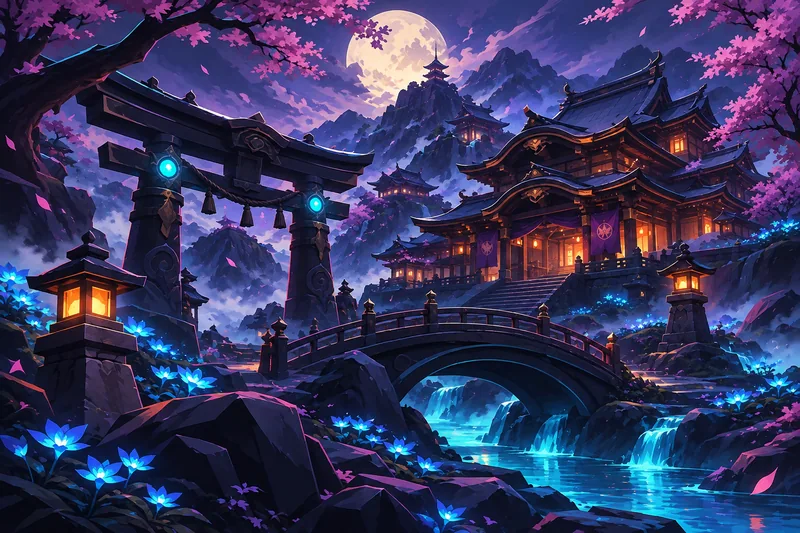
Old Master Sōkan always rinsed the cups at noon. He had done it for forty years in the truce-house at Fuji-no-Ichi, where the war between Heaven and Earth was not permitted to come indoors, and he saw no reason to stop on the day the sun went out.
It did not go out all at once. That was the strange part. At first it simply seemed that a cloud had crossed it, though the sky over the mountain was clean. Then the shadows of the maples in the garden began to lengthen, sliding east across the moss as if it were already evening. The carp in the pond rose to the surface and hung there, mouths open. A bush warbler that had been singing on the eaves stopped mid-phrase.
Sōkan set down the cup he was holding and went out onto the veranda.
The sun was still in the sky, directly overhead where it ought to be. But it was the colour of a coal that has been left too long, a dull orange coin, and he could look straight at it without his eyes watering. Around the garden the stone lanterns had no shadows at all. The light was everywhere and nowhere, grey and thin, like light seen through rice paper.
Behind him, guests came out of the tea rooms. A Court tax-officer in white silk. Two kitsune merchants from the Izumo road, ears flat. A Karasu-Tengu courier with her wings half-spread. Nobody spoke. Somewhere in the market town a temple bell began to ring, then another, and a dog started howling and would not stop.
"It is an eclipse," said the tax-officer, too loudly.
"Eclipses end," said one of the kitsune.
It did not end. By what should have been mid-afternoon the sky had settled into a long violet dusk that went on and on. Lanterns were lit in the shrine garden and their small flames looked brighter than the sun. Sōkan served tea, because people needed something to hold.
The news came in pieces over the following days, the way news always came to Fuji-no-Ichi: carried by travellers who did not know they were carrying it. From Heian-kyō, that the Mirror Gate offering had been made at dawn as always and that the High Priestess had heard nothing in reply. Nothing at all, for the first time in a thousand years. From the shrine roads, that Amaterasu had withdrawn into the Heavenly Rock Cave, as she had once done in the oldest of the old stories, and that this time no dance or mirror had drawn her out.
From the rice country, that the seedlings were yellowing in the paddies. From the coast, that the fishing kami had gone quiet in their shrines and the nets came up empty.
Then the blame began.
The Court said the Old Land had cursed the sun. Who else had a grudge against Heaven so old and so deep? Edicts went out from the Golden City demanding that the earthly kami surrender the sacred Regalia, the sword, the mirror and the jewel, to the Throne for safekeeping. And the Grand Chancellor, it was said, had begun to bind the dragon kings by force, chaining the great beasts of river and sea to drive back the dark with their power.
The Old Land said Heaven had brought this on itself. A smashed sacred mirror was found among the sea stacks off Izumo, the Amatsu sun upon it, and the elders read it as plainly as a letter. Then the earth itself shuddered along the coast, and the Kunitsu shamans whispered what no one wanted to hear: that the ancient seal upon the eight-headed Orochi had begun to crack.
Within a season, both sides had taken up arms.
Sōkan kept the truce-house open. Inari's foxes still sat on the gateposts, and the rule held: no blade drawn beneath the mountain. Officers from both courts drank his tea at opposite ends of the same room and did not look at one another.
Only once did anyone say something that stayed with him. A lady of the Court passed through late in that first strange autumn, radiant and witty, with a laugh like small bells. She admired his garden and asked after his health, and as she left she paused beneath a stone lantern and looked up at the dim, sullen sun.
"It is a little like a candle," she said, "when someone has cupped their hand around it."
Then she smiled at him and was gone. He found himself, afterwards, unable to remember her face. Only the faint smell of foxes on the veranda, and the feeling that she had meant something by it.
Old Master Sōkan hears every secret in the land and repeats none. But he has started watching the sky.