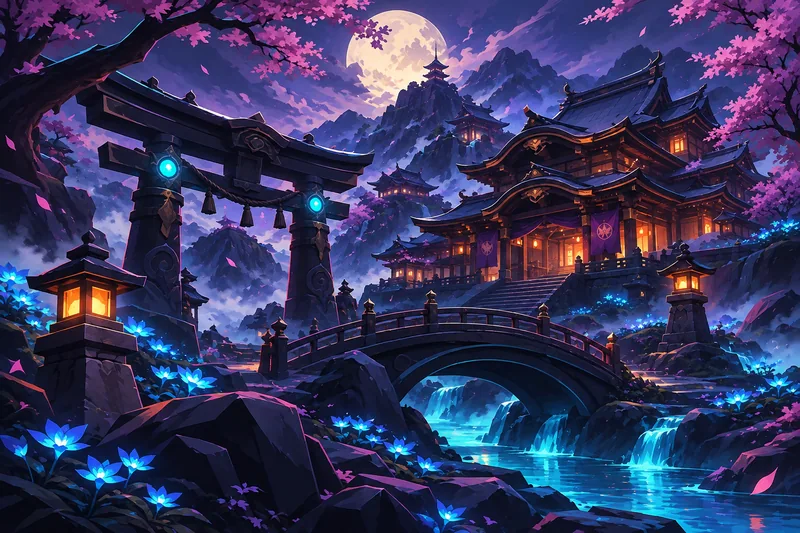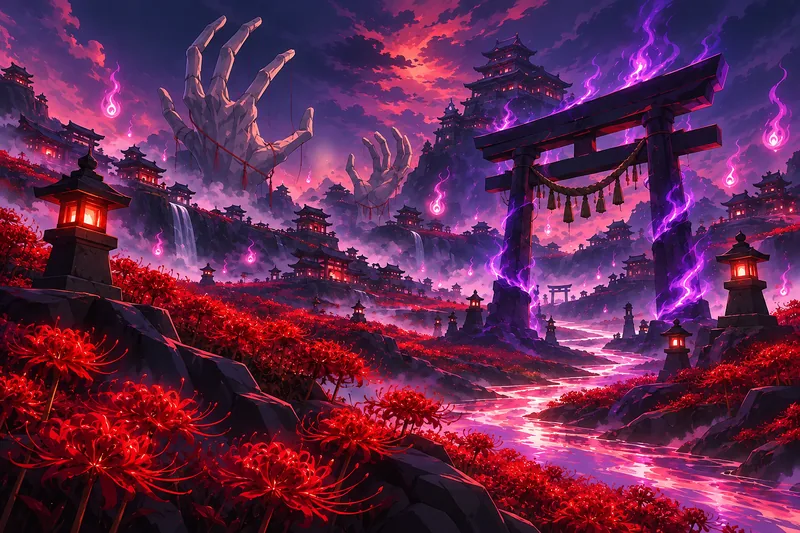
In the beginning there was no land, only a dark brine that did not know it was a sea. The first kami spoke, and because words carry spirit, their speaking made things so. Last of all they called forth a pair: Izanagi, He-Who-Invites, and Izanami, She-Who-Invites. To them they gave a spear hung with jewels and a single instruction. Make the world firm.
The two stood upon the Floating Bridge of Heaven and lowered the spear into the deep. They stirred, and the brine curdled and thickened, and when they lifted the spear a drop of salt fell from its point and hardened into an island. They stepped down onto it. It was the first ground anyone had ever stood on, and Izanami laughed at the feel of it beneath her feet.
There they built a hall and a pillar, and walked around the pillar from opposite sides, and when they met they spoke the words of marriage. From their union came the Eight Great Islands, rising one after another out of the sea like the backs of sleeping animals. After the islands came the gods of the islands: the kami of rivers and estuaries, of mountains and moors, of wind and of trees, of the grass that would one day feed horses and the rice that would one day feed people. The world filled with voices.
The last child was fire.
Kagutsuchi came out of his mother burning, and he burned her as he came. Izanami lay down in the hall she had built and did not rise. Even dying she gave birth, for gods are made of making, and from her sickness came the kami of metal, of clay and of water. Then she went still, and went down, and was gone.
Izanagi wept until his tears became a goddess of their own. Then he drew his sword and cut the fire-child into pieces, and from the blood came more gods still, for nothing in that age could die without becoming something. But none of them was Izanami.
So he went after her.
The road to Yomi runs downward, and it is long, and it does not care who walks it. Izanagi walked it until the light was a rumour behind him. At its end he found a great door, and behind the door he heard his wife's voice.
"You have come too late," she said. "I have already eaten at the hearth of this place. But wait. I will ask the gods of Yomi whether I may return. Only do not look at me while I ask."
He waited. He waited a long while, in a dark so heavy it seemed to lean on him. At last he could bear it no longer. He broke a tooth from the comb in his hair, set it alight, and stepped through the door.
What he saw in the light of that small flame was not his wife. It was what death had done to her. Maggots moved where her beauty had been, and eight thunder gods coiled upon her body like serpents. Izanagi let the comb fall and ran.
"You have shamed me," Izanami cried, and her cry went through the whole of Yomi. She sent the hags of the underworld after him, and the thunder gods, and an army of the dead. Izanagi flung his headdress behind him and it became grapes; he flung his comb and it became bamboo shoots, and the hags stopped to eat. At the foot of the slope that leads out of Yomi he found a peach tree and threw its fruit at the army, and the dead fell back.
Then Izanami came herself.
Izanagi heaved a boulder across the mouth of the road, a stone so great that a thousand men could not have moved it. They stood on either side of it, husband and wife, and spoke through the rock.
"For this," said Izanami, "I will take a thousand of your people every day."
"Then I will see fifteen hundred born every day," said Izanagi, and the words were binding, as words were then.
He went down to a river and washed the filth of Yomi from his body. From what he washed away came Magatsuhi, the spirit of calamity, and to balance it, Naobi, the spirit of repair. From his left eye came Amaterasu, the sun. From his right eye, Tsukuyomi, the moon. From his nose, Susanoo, the storm.
And behind the stone, in the dark, Izanami waited. She has always been very good at waiting.